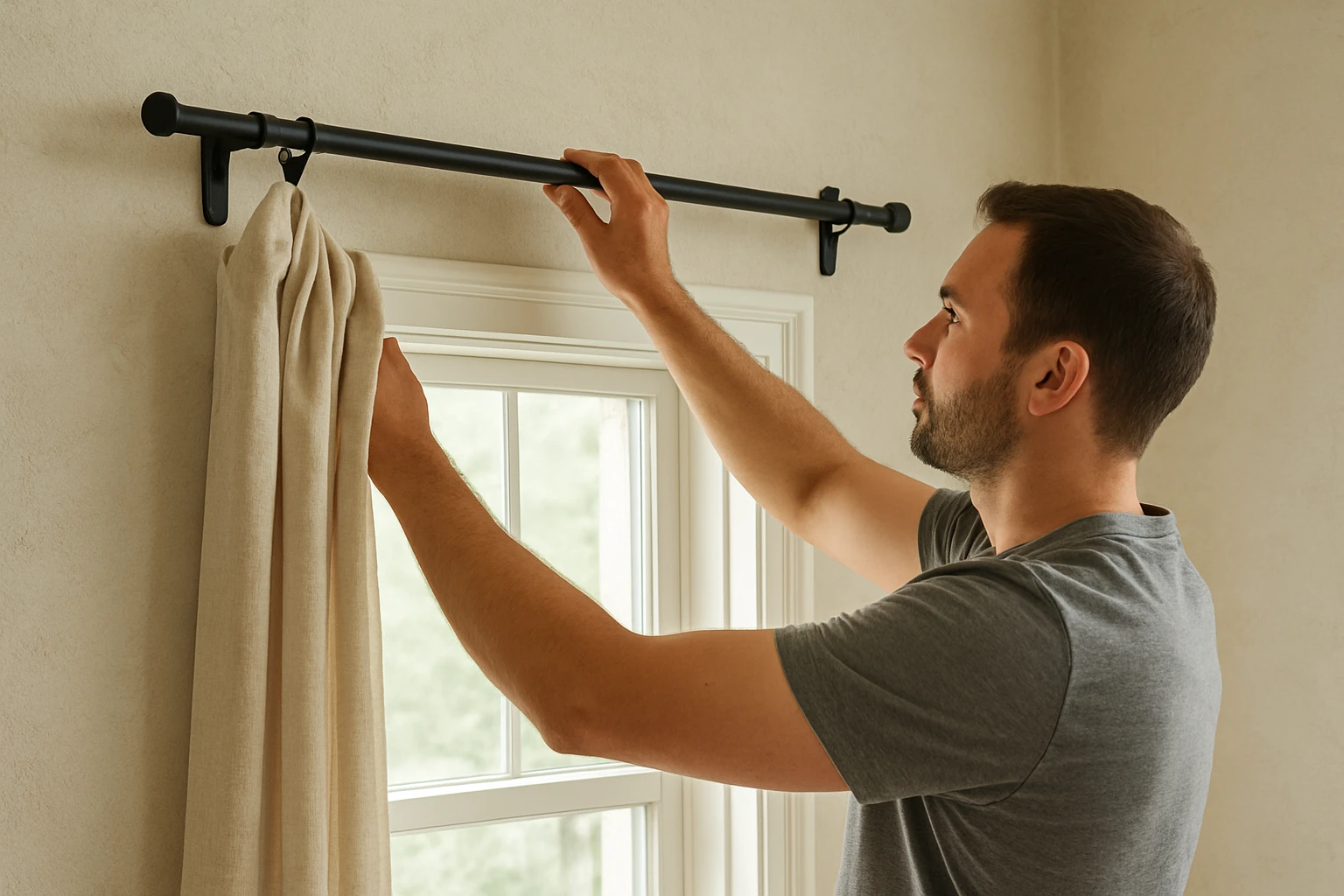


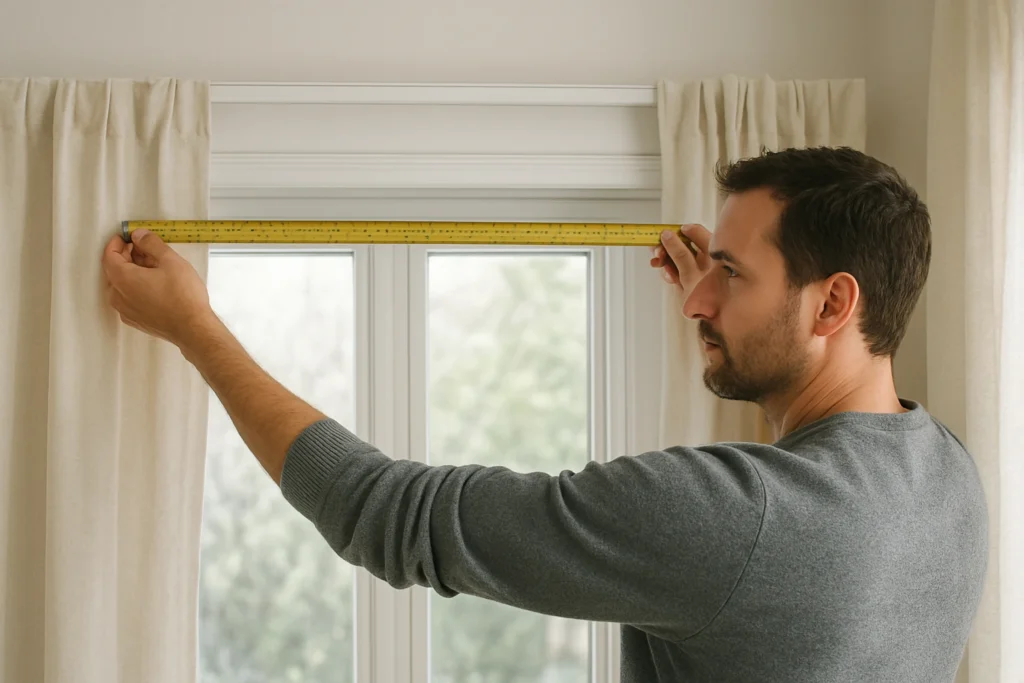
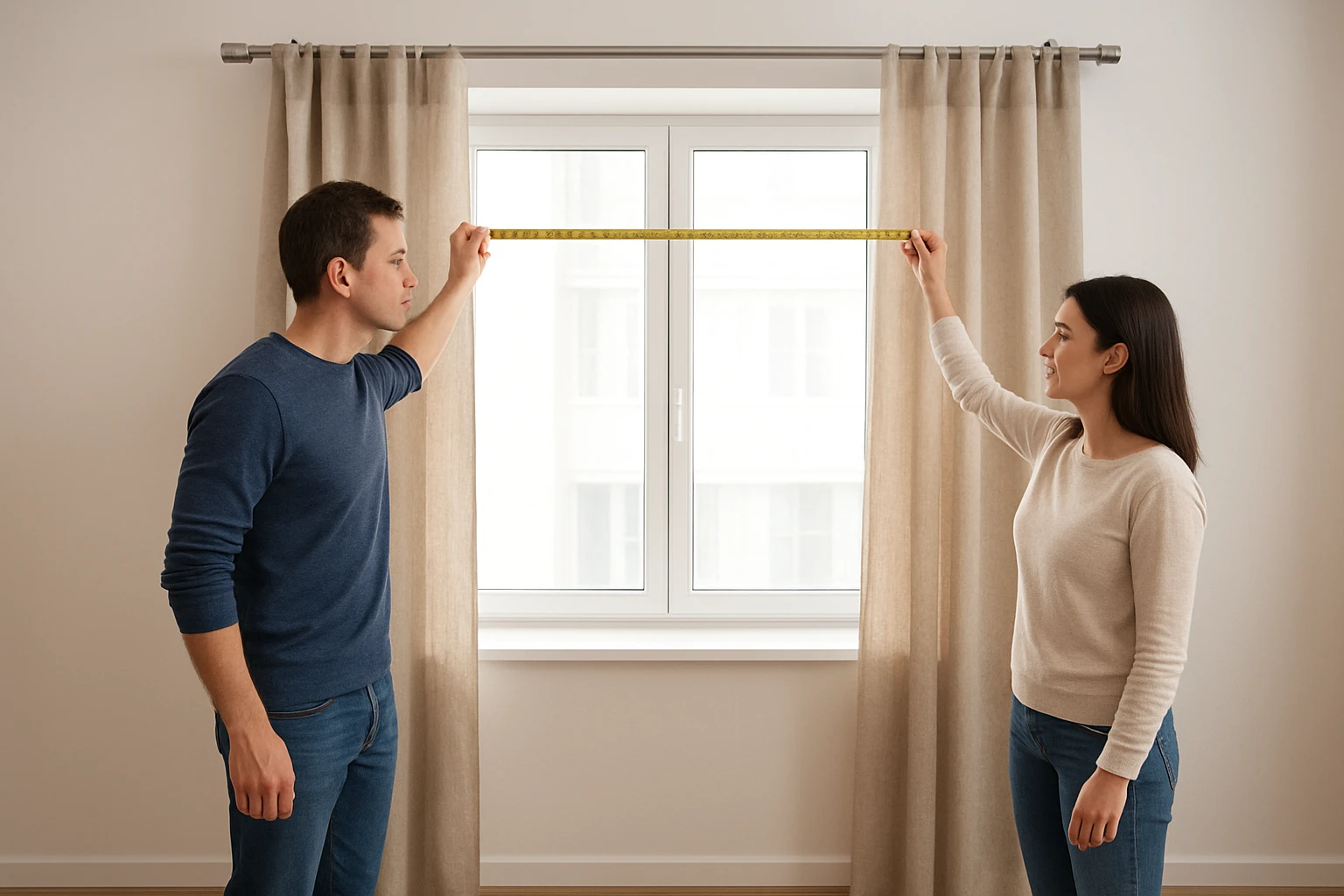
To measure for curtains, measure the usable width of the curtain pole or track, then measure from the correct hanging point to where the curtain should end. For many gathered curtain styles, the combined flat panel width is about 1.5 to 2.5 times the pole or track width, depending on the fabric and heading. Check the supplier’s measuring guide before ordering, because ready-made panels, made-to-measure curtains, and wave curtains can use different sizing rules.
What to Decide Before You Measure
Choose the curtain heading, pole or track position, and finished length before taking your final measurements. These choices set the width you need to cover and the point from which you measure the drop, which is the curtain’s finished length.
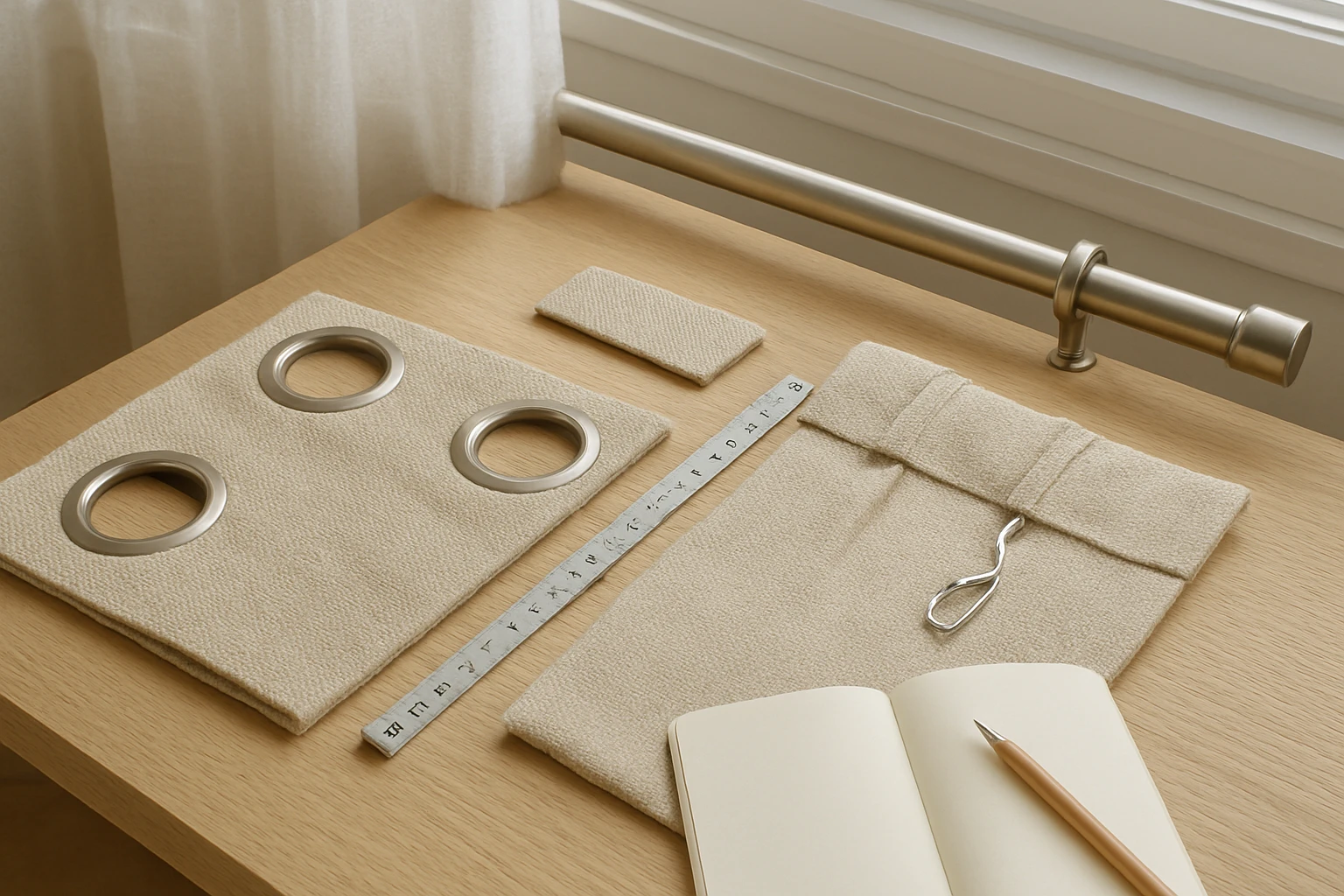
You need a steel tape measure, a pencil, and somewhere to record the figures. A fabric sewing tape can sag across a wide window, so it is less useful for measuring a pole or a long drop. Use centimetres or millimetres throughout rather than switching between units.
When ordering from The Curtain Shop, keep these three measurements separate in your notes:
- Window width, which describes the opening or frame.
- Pole or track width, which describes the area the curtains must cover.
- Finished curtain width, which may mean flat fabric width or gathered coverage, depending on the supplier.
Confusing these measurements is a common reason curtains arrive too narrow. A curtain made only as wide as the glass may leave gaps beside the frame, while a flat panel as wide as the pole will have little room for folds.
Fit the hardware before taking final measurements whenever possible. If it is not fitted, mark its planned position and treat the figures as estimates until the brackets and hanging points are confirmed. For help choosing a heading before measuring, compare the different types of curtains, since eyelet, pleated, and wave styles do not all hang from the same point.
How to Measure Curtain Pole or Track Width
Measure the usable length of the pole or track, not just the window frame. For a straight pole, measure between the decorative end pieces, called finials, and leave the finials out of the measurement.

Follow these steps for a standard straight window:
- Measure the full usable pole or track from end to end.
- Record whether one curtain or a pair will cover that span.
- Note any centre overlap or side returns, where the fabric turns back towards the wall.
- Check whether the supplier wants the hardware width or the total flat panel width before entering your order.
For a track with an overlap arm, do not guess how much extra to add. Give the supplier the track details and ask whether its measuring method already accounts for the overlap. Counting it twice can leave too much fabric at the centre.
If the Pole or Track Is Not Installed
For a standard window with clear wall space, extending the pole roughly 15 to 30 cm beyond each side of the frame is a useful starting point. This gives the curtains space to sit beside the glass when open, though wide windows and thick lined curtains may need more room.
For example, a window frame measuring 180 cm wide with 20 cm of pole beyond each side needs a pole with a usable width of 220 cm. The curtains must cover that 220 cm span, not just the 180 cm window.
The space taken up by open curtains is called stack-back. Heavy fabric and deep folds take up more space, so a fixed side allowance will not suit every curtain. If keeping the glass clear matters, ask the supplier to estimate stack-back for your chosen fabric and heading before buying the pole.
Also check the wall beside the window. A corner, wardrobe, or nearby door may stop you from extending both ends equally. For a new fitting, the curtain installation service can help if bracket positions, wall fixings, or track clearance need checking before the final measurements.
How Much Curtain Width Do You Need?
For many ready-made curtains, multiply the pole or track width by a fullness factor to find the total flat panel width. Fullness is the extra fabric that forms folds when the curtains are closed, rather than leaving them stretched flat.
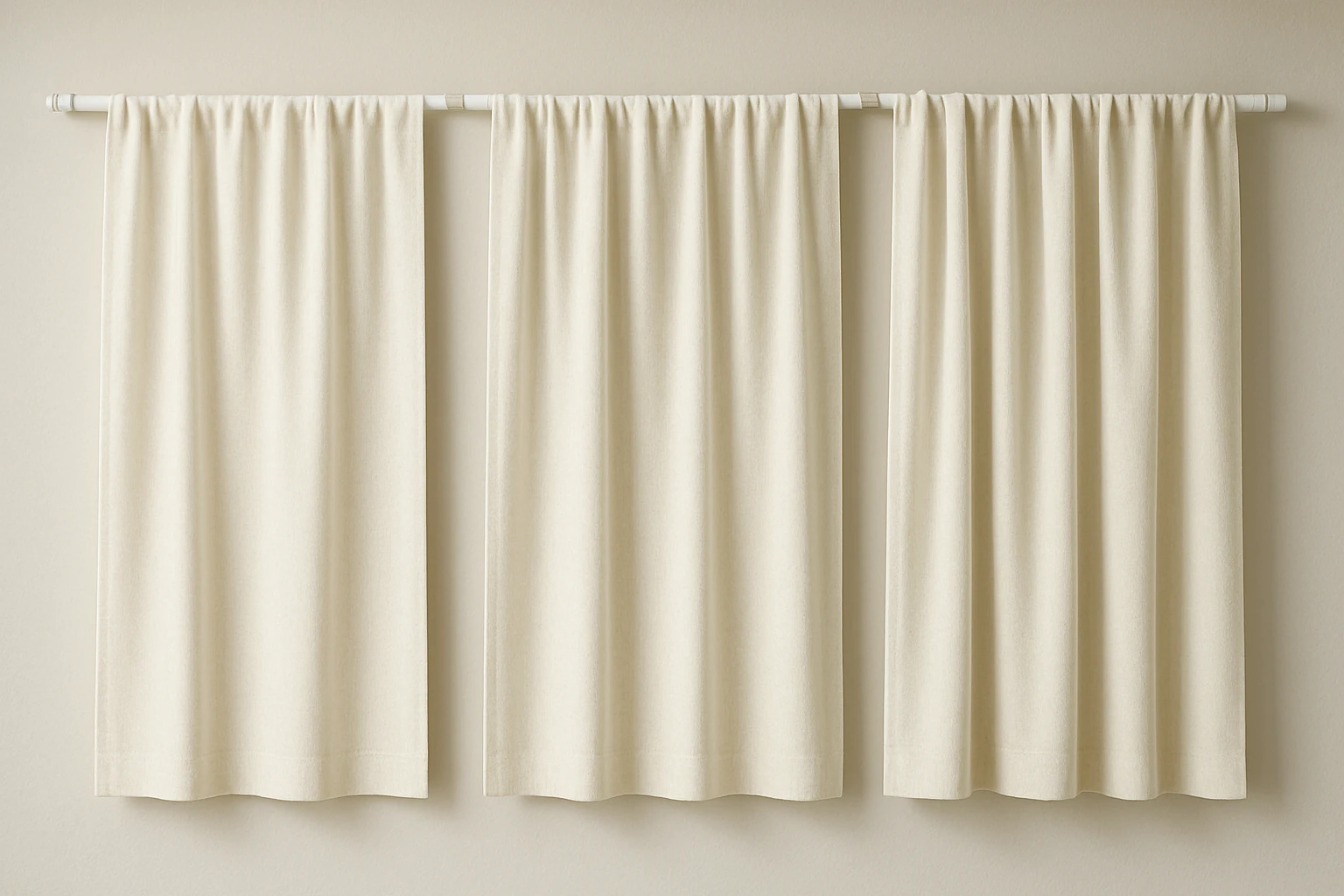
The following ranges are planning guides, not fixed rules. Always follow the heading design and the supplier’s instructions.
| Curtain Style or Fabric | Typical Planning Fullness | What to Check |
|---|---|---|
| Heavy fabric with a restrained gathered look | About 1.5 to 2 times | Too little fabric can leave the curtain looking flat when closed |
| Pencil pleat or eyelet curtains | About 2 times, sometimes up to 2.5 | Follow the product’s recommended pole coverage |
| Lightweight sheer curtains | About 2 to 2.5 times | Fine fabric often needs more width for visible folds |
| Pinch pleat curtains | Set by the pleat design | The supplier may quote the finished pleated width, not the flat fabric width |
| Wave curtains | Set by the track and heading system | Carrier spacing and heading tape control the required fabric width |
Calculating Ready-Made Panel Width
For ready-made curtains sold by flat panel width, multiply the pole width by your chosen fullness, then divide by the number of panels. Check the packaging first, because some listings show the width of each panel while others show the combined pair width.
For example, here is the calculation for a 220 cm pole at 2 times fullness:
| Calculation | Result |
|---|---|
| Pole width multiplied by fullness | 220 cm × 2 = 440 cm total flat width |
| Total flat width divided between two panels | 440 cm ÷ 2 = 220 cm per panel |
| If each available panel is 230 cm wide | Two panels provide 460 cm total flat width |
| Actual fullness with those panels | 460 cm ÷ 220 cm = about 2.1 times |
In this example, two 230 cm panels give a little more than double fullness. One 230 cm panel would cover the pole almost flat, so it would not create the same folded look.
If the available sizes leave you choosing between slightly more and slightly less width, check the recommended coverage range. More fabric is not always better, since bulky curtains need more space when open and place more weight on the hardware.
Ordering Made-to-Measure or Wave Curtains
For made-to-measure curtains, give the supplier the measurement its order form requests rather than adding fullness yourself. Many suppliers calculate fabric use from the track width and chosen heading, so multiplying that width again can create a costly sizing error.
Wave curtains need particular care because the folds depend on matching heading tape and spaced track carriers. Give the supplier the track system, usable width, panel split, and preferred opening direction. Follow that system’s instructions rather than applying a general rule of 2 times fullness.
These calculations describe finished curtain sizes, not how much loose fabric to buy for sewing. Fabric orders also need allowances for seams, hems, heading construction, and any pattern repeat.
How to Measure Curtain Length
Measure curtain length from the starting point used by your heading style to the intended bottom edge. Do not measure from the top of the window frame unless that is the actual hanging point specified by the supplier.
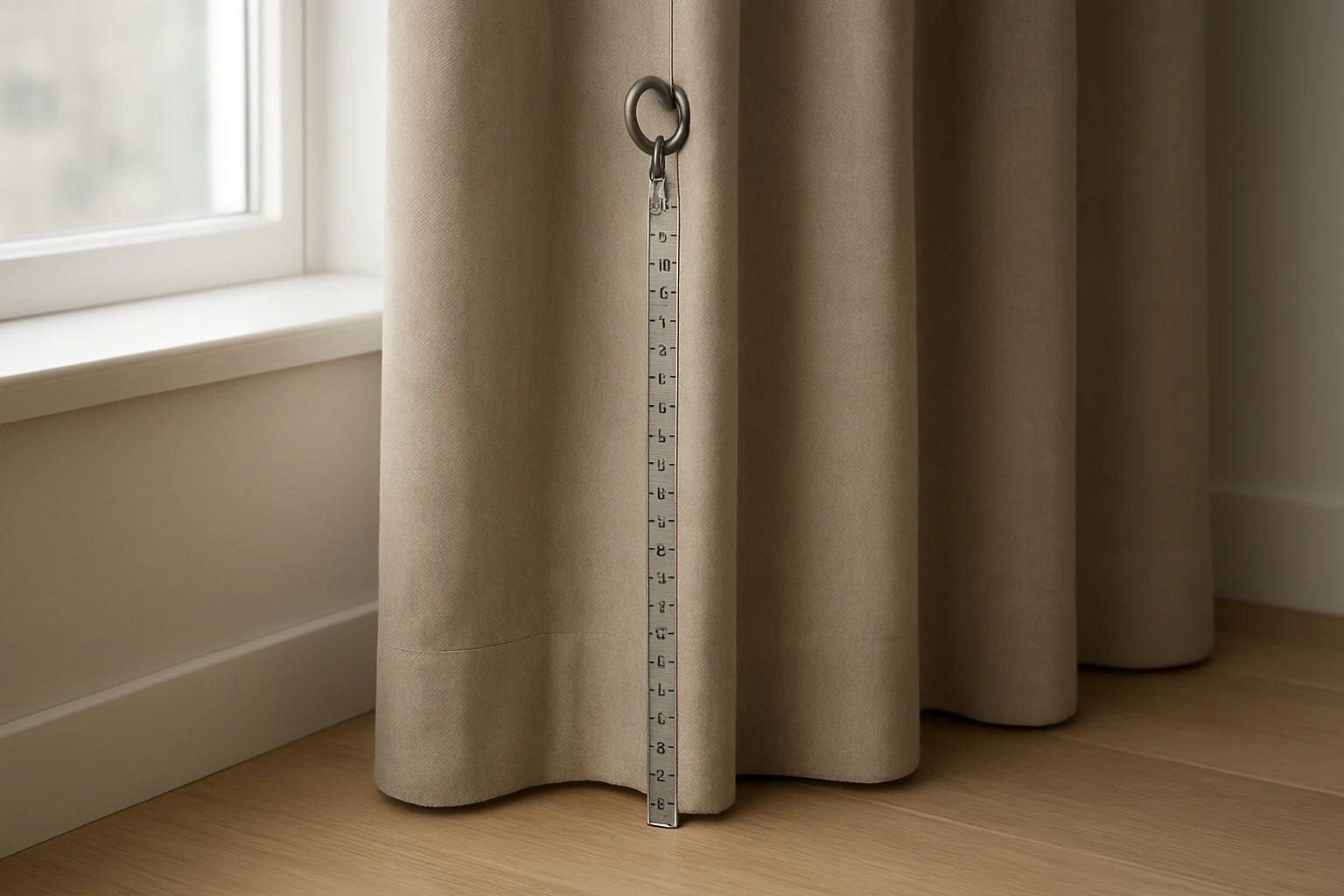
The top of the fabric and the point that carries its weight are not always in the same place. This matters with eyelet curtains, hook headings, and tracks hidden inside a ceiling recess.
| Heading or Hardware | Usual Measuring Reference | Detail That Can Change the Result |
|---|---|---|
| Eyelet curtain on a pole | Pole top, then account for fabric above the eyelet | Product length is commonly measured from the fabric top, so check the stated allowance |
| Curtain hung from pole rings | Hook attachment point at the ring | Adjustable hooks can raise or lower the curtain |
| Curtain hung from a track | Specified hook or carrier attachment point | Track design and hook position affect the finished top edge |
| Rod pocket or tab top | Reference point in the product guide | The pocket or tabs affect how the curtain sits on the pole |
| Wave curtain | Reference point specified for the track system | Do not assume the ceiling or track top is the correct starting point |
For eyelets, suppose the distance from the pole top to your chosen hem position is 240 cm, and the product has 3 cm of fabric above the eyelet. The finished fabric length would be about 243 cm. This is an example only, so use the actual eyelet position and the supplier’s method.
Choosing Where the Curtain Should End
Choose the bottom edge before measuring the drop, because floor-length and sill-length curtains need different clearances. Floor-length curtains often suit full-height windows, while shorter curtains may be more practical above a fixed bench or another obstruction.
| Finish | Practical Measuring Target | Best Used When |
|---|---|---|
| Above the sill | Around 1 cm above the sill | The curtain needs to move without catching |
| Below the sill | Often around 10 to 15 cm below | There is clear wall space and no heat source or furniture in the way |
| Just above the floor | Commonly around 1 cm clear | You want easy movement and less contact with dust |
| Touching the floor | Hem just meets the floor | The floor is level and precise adjustment is possible |
| Puddled on the floor | Add a chosen amount beyond floor level | The curtain is mainly decorative and will not cross a busy walkway |
For a practical floor-length example, if the correct hanging point is 249 cm above the floor and you want a 1 cm gap, the target drop is 248 cm. That figure only works if you measure from the supplier’s required starting point.
Measure the drop at the left, centre, and right of the curtain span. If the floor heights differ, using the shortest measurement helps a level hem avoid dragging, though the gap will be larger over lower parts of the floor. A curtain that touches the floor evenly may need a hem shaped to the floor rather than one standard drop.
Keep curtains clear of heaters, vents, and air-conditioning outlets, and follow any appliance clearance instructions. Decorative length should never take priority over safe placement.
Measuring Bay Windows, Layered Curtains, and Sliding Doors
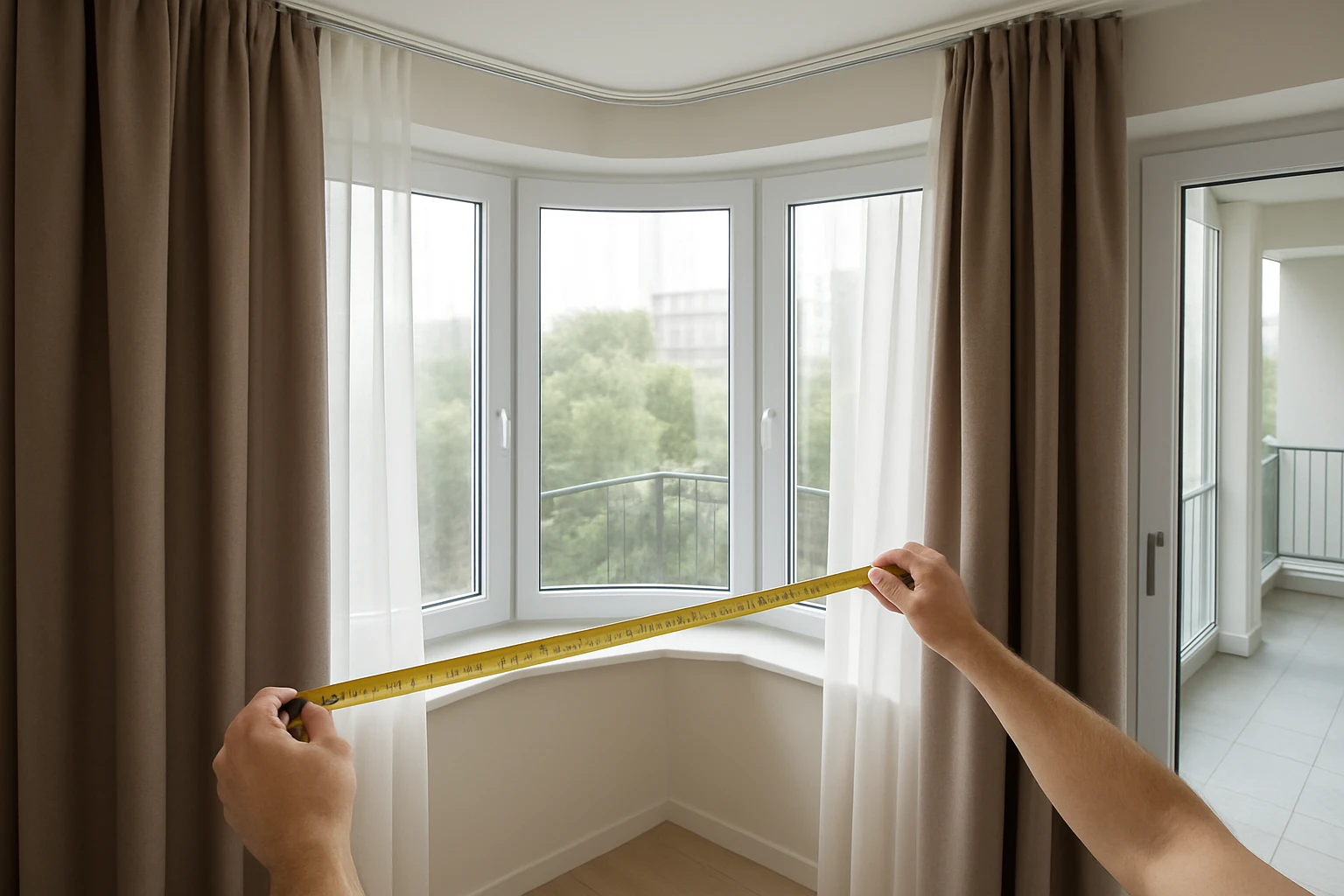
Bay windows, two-layer curtains, and sliding doors need measurements beyond a single width and drop. Record the shape, depth, and moving parts as well, because curtains can be the right size yet still catch on handles or block a doorway.
Bay and Corner Windows
Measure every straight section of a bay separately, and record the angles or shape using the track supplier’s template. The width straight across the front of the bay does not describe the full path that a bent track must follow.
Also record how far handles, sills, and vents extend from the wall. The track needs enough clearance for the fabric folds, not just enough room for the metal rail. With a curved or shaped track, confirm whether the supplier needs measurements along the track path, wall measurements, or a physical template.
Sheer and Blackout Layers
Measure the sheer and blackout tracks separately, since each layer has its own hanging point and may have a different usable width. The room-side track may sit lower or extend farther sideways than the track nearest the glass.
Leave enough space between tracks for both fabrics to move without rubbing. Deep folds and thick linings need more room than a light fabric with shallow folds, so ask the supplier to confirm the spacing for the actual curtain system.
If light control is the reason for using two layers, the blackout curtain and sheer curtain comparison can help you choose how to use each one. Extra fullness alone does not close light gaps above or beside a curtain. Track position, side coverage, and centre overlap also matter.
Sliding Doors and Wide Glass Walls
Plan where the curtains will sit when open before deciding how to split the panels. Equal panels suit many windows, but a single curtain or an uneven split may work better when one side of a balcony door is used every day.
Check the full path of the door handle and keep the open curtains clear of the walking route. For a very wide opening, confirm that the pole or track can carry the fabric weight and that centre supports will not stop the curtain moving as planned. A longer pole is not enough if its supports prevent the rings from crossing the required span.
Check These Details Before You Order
Before ordering, confirm how the supplier measures width and length, and how many panels come in each pack. Recheck the measurements after installation or any change to the heading, because even a small change in the hanging point affects the hem position.
Use this order sheet to keep measurements and choices together:
| Detail to Record | Example Only |
|---|---|
| Room and window | Bedroom, main window |
| Hardware | Straight pole with rings |
| Usable pole width | 220 cm, excluding finials |
| Heading | Pencil pleat with hooks |
| Number of panels | Two, opening from the centre |
| Width basis | Ready-made flat panel width |
| Chosen panel width | 230 cm each |
| Length reference | Hook attachment point at the ring |
| Hanging point to floor | 249 cm at the shortest measured position |
| Desired floor clearance | 1 cm |
| Target drop | 248 cm, subject to the supplier’s measuring method |
| Other details | Lining, handle clearance, and wall return requirements |
Do not round every figure to the nearest standard size while measuring. Record the actual dimensions first, then decide whether a ready-made size, a hem adjustment, or a custom order suits the window.
For custom curtains, read the Custom Order Policy before confirming dimensions or approving production. Also check the Return and Refund Policy rather than assuming an incorrect size can be exchanged.
The final check is simple: the width must match the supplier’s definition, and the drop must start at the correct hanging point. Once those two details are clear, check the panel count, opening direction, and floor clearance before placing the order.
Frequently Asked Questions
Should I Wash Curtains Before Shortening Them?
Wash washable curtains before shortening them if the care label and supplier allow it, because the fabric may shrink. Let them dry as directed before checking the length again. Do not wash dry-clean-only fabric or lined curtains against their care instructions, and ask the supplier how shrinkage is handled for custom orders.
Can I Use My Old Curtains as a Measuring Guide?
You can use old curtains as a guide if they fit well and the new curtains use the same hardware and heading. Measure their finished width and length, but also check the installed pole or track. Old fabric may have stretched or shrunk, and a different heading can change the final hem position.
How Do I Convert Curtain Measurements from Inches to Centimetres?
Multiply inches by 2.54 to convert curtain measurements to centimetres, or divide centimetres by 2.54 to get inches. For example, 90 inches equals 228.6 cm. Keep the original measurement in your notes and avoid rounding until you compare sizes, because small rounding changes can affect floor clearance.
Do Motorised Curtains Need Different Measurements?
Motorised curtains need measurements that match the chosen track system, including space for the motor and brackets. The supplier may also need the power point location, opening direction, and curtain weight. Confirm the system before ordering fabric, because the motor position and end fittings can affect the usable track span and curtain stack.
How Long Should New Curtains Hang Before I Check the Hem?
New curtains should hang until the fabric has settled before you make a final hem adjustment, following the supplier’s advice for that material. Heavy or loosely woven fabrics can relax after hanging, while packing creases may hide the true fall. Keep the curtains dry and avoid stretching them by pulling on the bottom edge.